

The Times Square Ball Drop began on December 31, 1907, when a 700-pound iron and wood ball lit with 100 light bulbs was lowered by hand from the flagpole atop the Times Tower. Since then the Ball has been rebuilt again and again, from wrought iron to aluminum to Waterford crystal, and today’s Constellation Ball weighs 12,350 pounds. Here is the whole story, and how the Ball changed through the years.
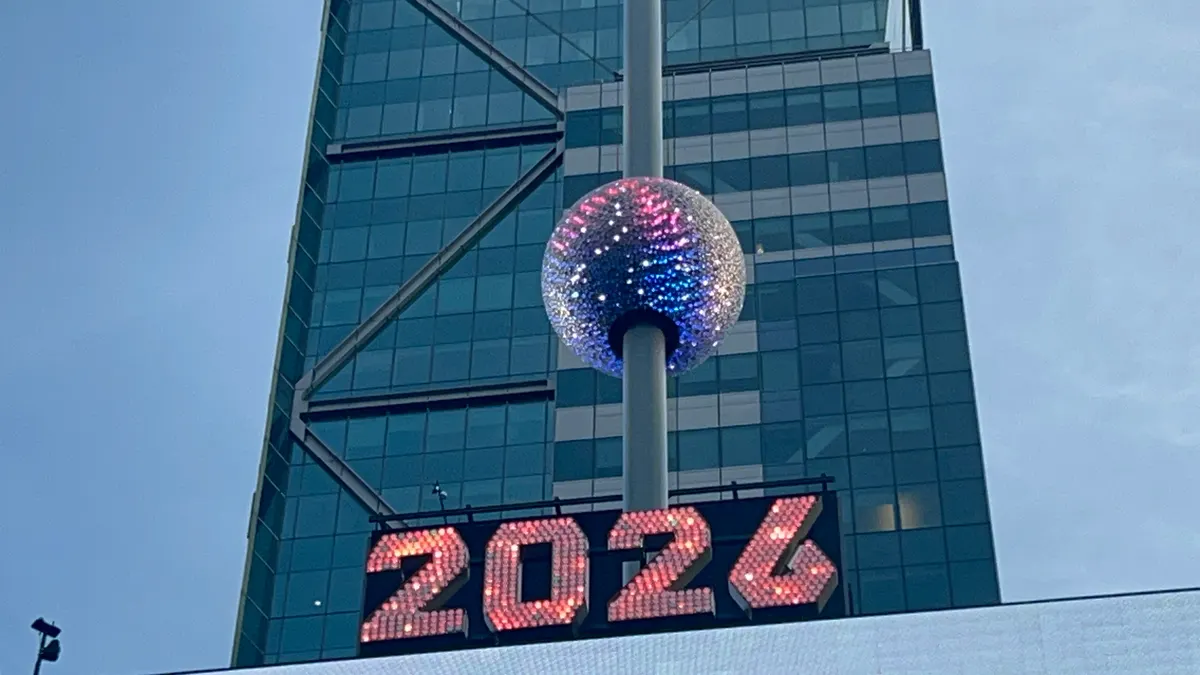
How it started: the 1904 party
New Year’s Eve in Times Square began in 1904. The New York Times had just moved into its new tower, and the paper’s owner, Adolph Ochs, had persuaded the city to rename the neighborhood, then called Longacre Square, after his newspaper. To celebrate, he threw an all-day street party that ended with fireworks at midnight. Close to 200,000 people came, and Times Square replaced Trinity Church downtown as the place New Yorkers rang in the new year.
1907: the first Ball drops
After a few years the city stopped the fireworks over the crowd, and Ochs wanted a bigger show. The Times’ chief electrician, Walter F. Palmer, suggested a time-ball, like the one he had seen on the Western Union Telegraph Building downtown. Sign maker Artkraft Strauss, led by a young immigrant metalworker named Jacob Starr, built a 5-foot ball of iron and wood, weighing 700 pounds and lit with 100 incandescent bulbs.
On December 31, 1907, a team of six men lowered it down the tower’s 70-foot flagpole with rope. When it touched down it completed an electric circuit that lit up “1908” signs on the building, and waiters at nearby hotels flipped on battery-powered top hats that spelled out “1908” in tiny bulbs.
Every Ball at a glance
- Iron and wood5 feet across, 700 pounds, 100 light bulbs, lowered by hand.
- Wrought ironSame size, 400 pounds.
- No dropThe wartime dimout. Crowds marked midnight with a minute of silence and chimes.
- AluminumA 6-foot aluminum “cage” of just 150 pounds.
- The Big AppleRed bulbs and a green stem for “I Love New York.”
- Rhinestones and computers12,000 rhinestones, strobes, and a computer-controlled drop.
- Waterford crystalThe millennium Ball: 504 crystal triangles, 1,070 pounds.
- The Centennial BallLEDs replace bulbs for the 100th anniversary.
- The Big Ball12 feet across, nearly six tons, up all year.
- The Constellation Ball12.5 feet, 12,350 pounds, 5,280 circular crystals.
How the Ball changed through the years
Each new Ball followed the lighting technology of its day: incandescent bulbs, then halogen lamps and strobes, then LEDs, and now light that reacts to music. Here is what changed with each one.
1907–1919 The first Ball: iron and wood
5 ft · 700 lb · 100 incandescent bulbs
Built by Artkraft Strauss and lowered by six men pulling on ropes, the first Ball set the pattern that still holds: a lit sphere sliding down the flagpole to land exactly at midnight. Artkraft Strauss went on to run the drop for most of the twentieth century.
1920–1955 Wrought iron, and two dark years
5 ft · 400 lb · all iron
The second Ball kept the same size but dropped the wood, saving 300 pounds. It is also the Ball that went dark: in 1942 and 1943 a wartime “dimout” switched off the lights of New York, and the drop was suspended. People came anyway, and greeted the new year with a minute of silence followed by the sound of chimes from trucks parked at the base of the tower.
1955–1998 The aluminum Ball
6 ft · 150 lb · aluminum frame
The third Ball was a light aluminum cage, a fraction of the weight of the iron Balls, and it had the longest run of any: 44 drops. It changed its look several times. From 1981 to 1988, red bulbs and a green stem turned it into a Big Apple for the “I Love New York” campaign, and for 1990–91 it glowed red, white and blue to salute the troops of Operation Desert Shield.
The biggest change came in 1995: 12,000 rhinestones, 180 halogen bulbs, 144 strobe lights and a computerized lighting system. The drop itself went digital too, run by an electric winch synchronized to the official U.S. atomic time signal, the same system that has timed every drop since.
1999–2007 The crystal Ball
6 ft · 1,070 lb · 504 Waterford crystal triangles · 600+ halogen lamps
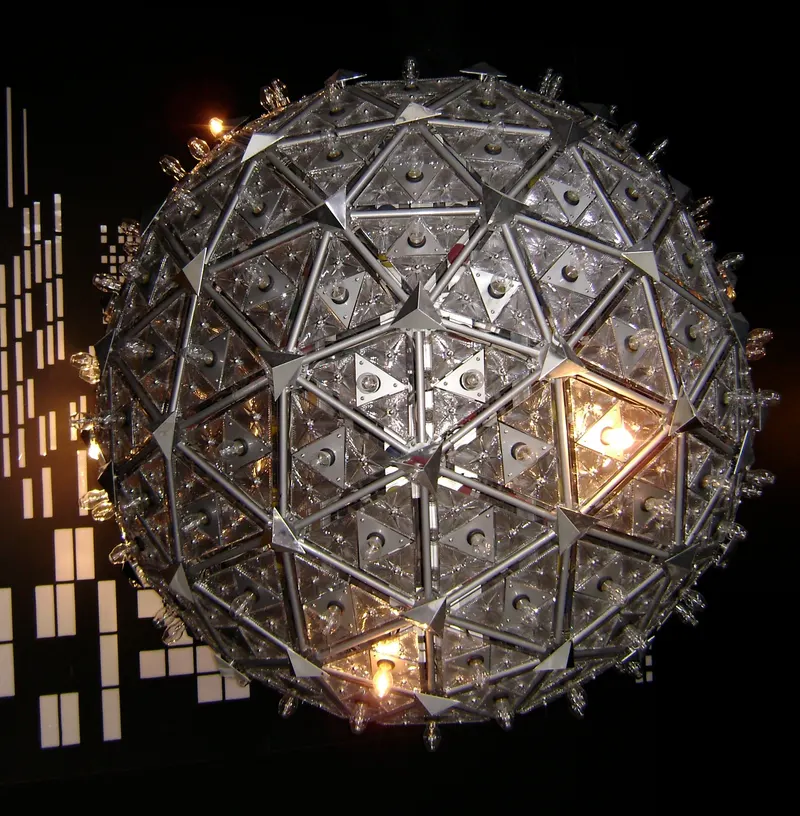
For the year 2000, the Ball was rebuilt from scratch by Waterford Crystal in Ireland. Its 504 crystal triangles were lit by more than 600 halogen lamps and 96 strobes, with spinning mirrors inside. The crystals carried a design called the “Star of Hope,” and from then on the panels were swapped each year for a new theme. The 2001 “Hope for Healing” panels, made after September 11, are now in the permanent collection of the National September 11 Memorial & Museum.
2007–08 The Centennial Ball
6 ft · 1,212 lb · 672 crystals · 9,576 LEDs
For the drop’s 100th anniversary, LEDs replaced bulbs for the first time. The Centennial Ball could show millions of colors and used about as much electricity as ten toasters. It dropped just once.
2008–2025 The Big Ball
12 ft · 11,875 lb · 2,688 crystals · 32,256 LEDs
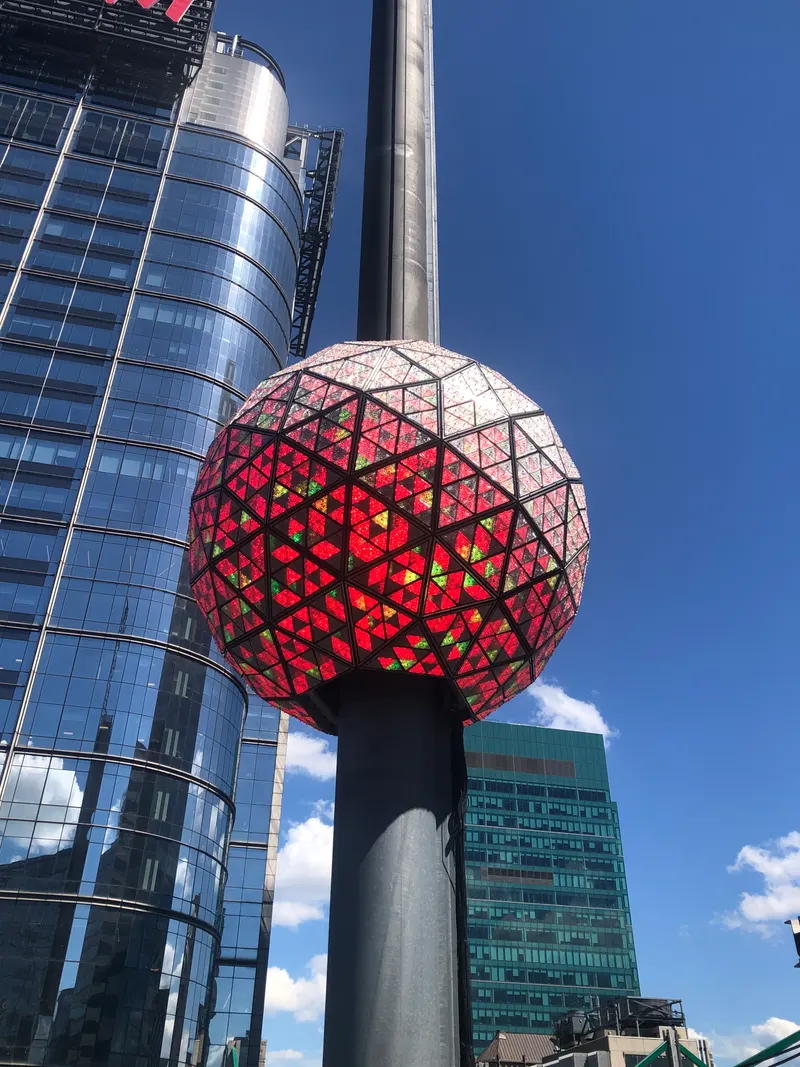
The Centennial Ball inspired something much bigger: a 12-foot geodesic sphere weighing nearly six tons, twice the size of any Ball before it. It was built to be weatherproof, so for the first time the Ball stayed on top of One Times Square all year instead of coming down after New Year’s. Its crystals followed Waterford theme series such as “Let There Be Light” and “Gift of Wonder.” It dropped 17 times, through the night that welcomed 2025.
2025–today The Constellation Ball
12.5 ft · 12,350 lb · 5,280 circular Waterford crystals · audio-reactive LEDs
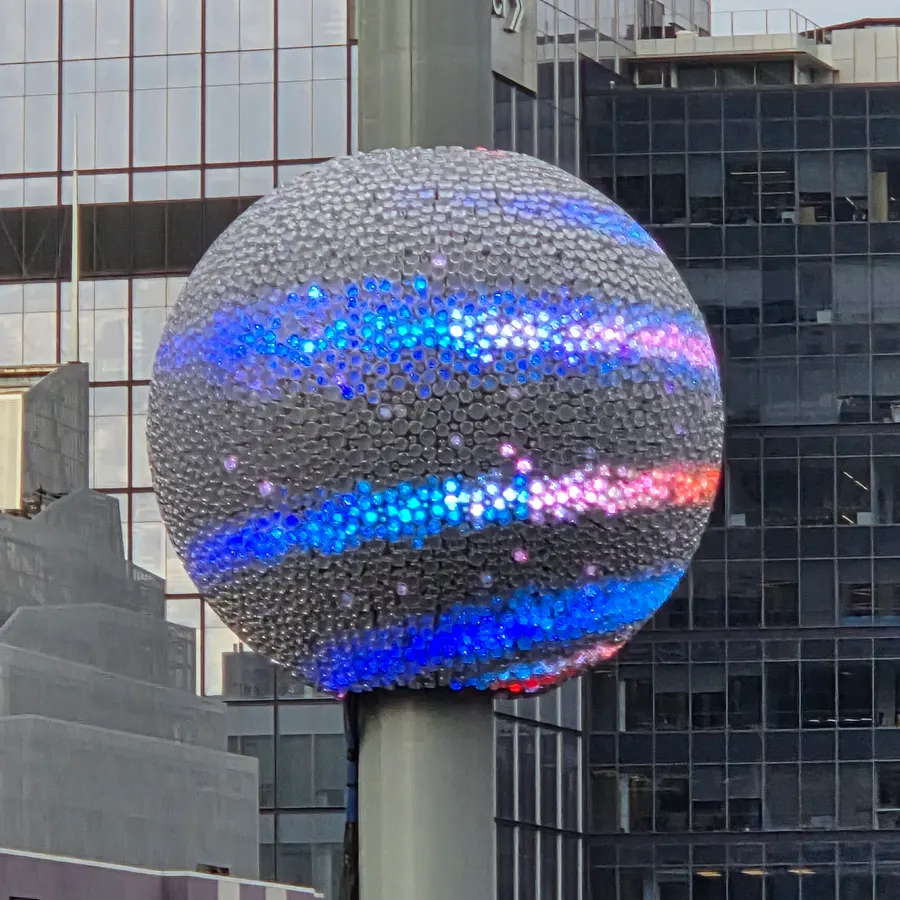
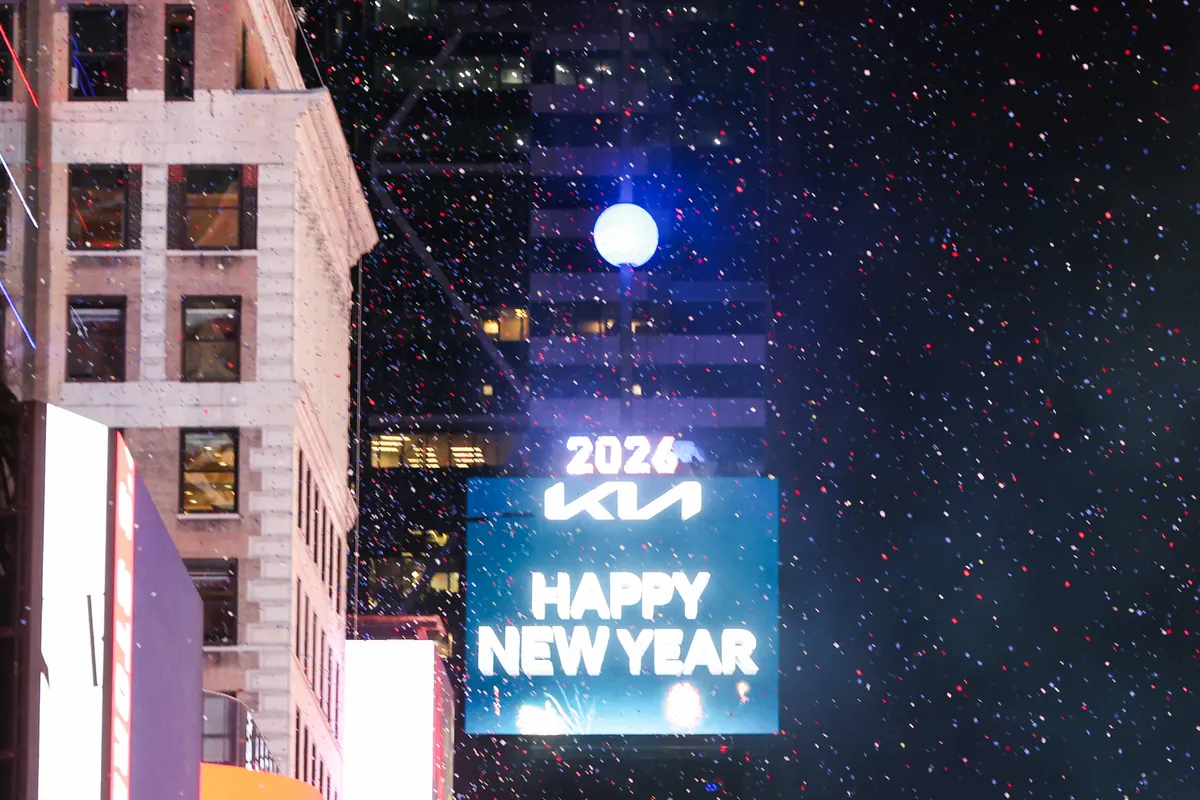
The current Ball was unveiled on November 24, 2025, with the new observation deck at One Times Square, and dropped for the first time on the night that welcomed 2026. It is the biggest Ball yet, and the first to drop the triangle: its 5,280 circular Waterford crystals come in three sizes, 1.5, 3 and 4 inches across. Its LED light pucks can react to music in real time, and the “2026” numerals below it got new multicolor lights too.
Its crystals carry Waterford’s “Infinite Edition” designs: “Infinite Joy,” “Infinite Light” and “Infinite Beginnings” for the first year, and “Infinite Life,” “Infinite Liberty” and “Infinite Happiness” for 2026, after the Declaration of Independence. You can now see the Ball up close from the observation deck, where it is lowered for visitors during the day.
2026: the Ball drops in July
In 2026 the Ball broke with more than a century of tradition. Just after midnight on January 1, it rose again in red, white and blue to start America’s 250th birthday. Then, on July 3 and 4, 2026, it was lowered eight times, once for midnight on Independence Day in each U.S. time zone: the first time the Times Square Ball had dropped for anything other than New Year’s Eve.
Where the idea came from: time-balls
Dropping a ball to mark the time is older than New Year’s Eve in Times Square. In 1833, a “time-ball” was installed on top of the Royal Observatory in Greenwich, England. It dropped at one o’clock every afternoon so ships’ captains could set their chronometers. Around 150 public time-balls followed around the world. Times Square turned that daily signal into a once-a-year moment that more than a billion people now watch.
Times Square Ball Drop history: questions people ask
When did the Times Square Ball Drop start?
The first Ball dropped on December 31, 1907, to welcome 1908. New Year’s Eve parties in Times Square started earlier, in 1904.
Who started the Times Square Ball Drop?
Adolph Ochs, owner of The New York Times, created the tradition after the city stopped his fireworks. The first Ball was built by Jacob Starr’s sign company, Artkraft Strauss.
How big is the Times Square Ball?
Today’s Constellation Ball is 12.5 feet in diameter, the largest Times Square Ball ever. The first Ball, in 1907, was 5 feet across.
How much does the Times Square Ball weigh?
The Constellation Ball weighs 12,350 pounds. The lightest was the 1955 aluminum Ball, at 150 pounds.
How many Times Square Balls have there been?
The Times Square Alliance counts the Constellation Ball, introduced in 2025, as the ninth.
Has the Ball ever not dropped?
Yes, twice: in 1942 and 1943, during the World War II dimout. Crowds still gathered and marked midnight with a minute of silence and chimes.
Has the Ball ever dropped on another day?
Yes. On July 3 and 4, 2026, it was lowered eight times for midnight on Independence Day in each U.S. time zone, for America’s 250th birthday.
Can you see the Times Square Ball up close?
Yes. Since November 2025 the observation deck at One Times Square lets visitors see the Constellation Ball, which is lowered during the day for viewings.
More than a century later, the countdown still ends the same way. Where will you be when the Ball drops? Here’s what to expect on the night.
